
Cold Chain Logistics Math: Why “Upgrading” to a Thicker Cooler Can Cut Your Shipping Costs by Up to 66%
When shipping temperature-sensitive products—whether specialty meats, artisan foods, or sensitive pharmaceuticals—nothing triggers anxiety for cold chain logistics managers like the risk of a spoiled package arriving on a customer’s doorstep.
For many growing shippers, that paranoia leads directly to a default operational playbook: buy thinner 1″ insulated coolers to minimize packaging costs, and lean entirely on expensive overnight courier delivery to ensure the payload arrives cold.
It feels like the safe play. Thinner coolers cost slightly less per unit, take up less incoming freight volume, and get your shipment there fast.
Except there is a major blind spot in this equation: You are paying the carrier an enormous premium to do a job that an extra half-inch of foam insulation could handle for a fraction of the price.
Here is a breakdown of the math, the operational trade-offs, and why upgrading from a 1″ wall to a 1.5″ cooler might be the single fastest way to cut your total landed logistics costs.
The Real Cost Driver: Outbound Transit Rates
To see why the “thin cooler + air freight” strategy leaks money, you have to look at the entire lifecycle cost of a cold-chain pack-out, not just the unit price on your packaging invoice.
-
Inbound Freight & Unit Cost: Yes, a 1.5″ cooler carries a marginally higher material cost than a 1″ box. Furthermore, because the foam walls are 50% thicker, fewer units fit on an inbound pallet, resulting in slightly higher inbound freight per unit.
-
Outbound Delivery Freight: Outbound delivery charges represent the single largest ongoing expense in direct-to-consumer and B2B cold distribution. Moving a package via Priority Overnight or Next-Day Air routinely costs 3x to 5x more than standard 1–3 day ground shipping for the exact same destination zone.
When shippers rely on 1″ coolers, they are forced into next-day transit because a 1″ foam barrier does not offer sufficient thermal resistance (R-value) to survive unexpected regional hub delays, summer tarmac heat, or 48-to-72-hour transit cycles.
By trading up to a 1.5″ wall, you increase your thermal retention window dramatically. That added thermal barrier allows you to shift shipments safely from expensive overnight express into economical 1–3 day ground services. This slashes your outbound cold chain logistics freight costs by up to two-thirds (66%).
Running the Trade-Off Analysis
Let’s weigh the trade-offs across the two operational approaches:
| Factor | Option A: 1″ Cooler + Overnight Air | Option B: 1.5″ Cooler + 1–3 Day Ground |
| Packaging Unit Cost | Slightly lower upfront purchase price. | Modest step-up in unit price per cooler. |
| Inbound Freight & Density | More flat units per pallet; lowest inbound shipping cost per cooler. | Fewer flat units per pallet; slightly higher freight per incoming unit. |
| Thermal Runway (R-Value) |
Limited; vulnerable beyond 24–36 hours in warm ambient conditions. |
Substantially higher; holds target temps safely across 48–72 hour ground routes. |
| Outbound Shipping Cost | Premium (Overnight/Air): High carrier rates that compress customer margins. | Economical (Ground): Up to 66% lower outbound shipping spend per package. |
| Operational Stress |
Constant urgency; any minor courier delay risks total product loss. |
Built-in thermal buffer that withstands weather delays or missed scans. |
Even after factoring in the minor increases in cooler purchase cost and inbound pallet density, the massive outbound freight savings of moving from air to ground dwarfs the difference within just a few shipments.
Overcoming the Inbound Bulk Penalty with Fold-Flat EPS
Historically, moving from a 1″ cooler to a 1.5″ cooler carried a massive secondary headache: warehouse storage space. Rigid molded foam coolers are 90% trapped air, and thicker molded boxes consume vast amounts of warehouse staging floor space.
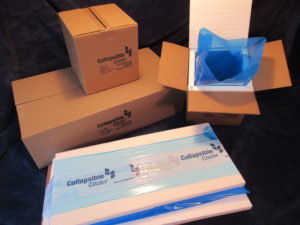
This is where fold-flat insulation technology changes the economics:
-
Compact Storage: Unlike rigid molded coolers, collapsible EPS panels store and stage completely flat, cutting storage space requirements by 50% to 80% compared to pre-formed boxes.
-
Rapid Deployment: Panels unfold into rigid, heavy-duty 3D coolers in seconds right at the packing station.
-
Custom Sizing Without Mold Fees: Stepping up to 1.5″ wall thickness doesn’t require five-figure tooling investments or waiting weeks for new production runs. Cut-to-order manufacturing lets you dial in the exact payload cavity you need without paying for dead airspace.
The Verdict: Stop Letting the Carrier Eat Your Margins
If your cold chain logistics process relies on expensive overnight shipping out of fear that ground transit will spoil your product, you are subsidizing air couriers instead of investing in adequate insulation.
Upgrading to a 1.5″ wall cooler gives your payload the thermal endurance it needs to ride the ground network reliably. You spend pennies more on incoming foam to save tens of dollars on every outgoing label.
Ready to see how ground shipping economics look for your product line? Request a sample 1.5″ thick cooler or custom spec cooler tailored to your exact payload dimensions, and let’s run the thermal numbers together.